ADHD coaching in South Carolina is becoming an increasingly popular option for families seeking practical, compassionate support for their children and teens.
Maybe your child has recently been diagnosed with ADHD—or perhaps you’ve heard from teachers or counselors that they’re struggling with executive function challenges.
So what’s the next step?
Naturally, as a parent, you choose to advocate—because you know your child’s potential.
You see their creativity, their unique strengths, their light…and you want the world to see that light too.
Right now, though… that light might feel a little shaded.
- By not being able to get started.
- By late assignments.
- By forgotten books.
- By meltdowns after school.
- By mornings that start in stress and evenings that end in overwhelm.
- By a room where you can’t see the floor.
But the thing is—none of this means your child can’t thrive. It means they need the right support to bridge the gap between their abilities and their daily challenges.
That’s where ADHD coaching comes in.
Let’s explore why more and more families in South Carolina are choosing ADHD coaching—and how it can help your child shine.

How ADHD Coaching in South Carolina Helps Build Executive Function Skills
Let’s talk about real strategies for managing executive function challenges and ADHD.
The good news? If you live in South Carolina, there are many helpful supports available to families.
IEP and 504 plans can be a huge step forward—these school-based accommodations help students by providing extra time, quiet testing spaces, note-taking supports, and more. These tools help level the playing field, and in many cases, they’re essential.
School counselors and teachers are another resource—many work hard to check in with students and provide organizational help and encouragement.
And of course, you, as a parent, are already advocating for your child. You’re here, reading this, which says everything about your dedication. Parents can do a lot—helping set up systems at home, building routines, and teaching key life skills.
But here’s the thing: Coaching takes this support to the next level.
Why? Because:
- Coaches can provide dedicated 1:1 time that’s hard to get at school—most IEP/504 services are limited by availability and staffing.
- Coaching focuses on building executive function skills, not just accommodations. Think: time management, task initiation, emotional regulation, planning, and organization.
- Not every student qualifies for accommodations—An ADHD Coach is an option for all students who need it — even without an official diagnosis. This can be someone who just wants to work on executive functioning skills or has some form of neurodivergence that can benefit from working with a coach
- Coaching is completely personalized—students get strategies tailored to their brain, schedule, and goals.
- It’s outside the parent-child dynamic—let’s be real: sometimes teens and young adults just aren’t open to hearing advice from a parent. A coach becomes a neutral, trusted partner.
- Coaches can coordinate with parents and schools—but they also give the student their own space to practice and grow independently.
At the heart of it: ADHD coaching in South Carolina helps students move from “getting by” with accommodations to building true, lifelong executive function skills—the kind that serve them in school, at home, in college, and beyond.
It’s about helping your child develop the tools to shine—in ways that go far beyond what’s written in a school plan.
If reminders, rewards, and “just try harder” aren’t working, there’s a reason. Discover what actually helps an ADHD brain get moving.
Why Parents Are Turning to Coaching
Every family’s journey is unique—but when we talk to parents across South Carolina, certain themes come up again and again.
Here are some of the top reasons families are choosing ADHD coaching in South Carolina:
✅ School supports aren’t enough
Even with an IEP or 504, many students still struggle with organization, planning, and follow-through—skills that accommodations alone don’t fully teach.
✅ Stress at home is rising
When daily routines turn into battles, and homework leads to tears (from kids and parents), outside coaching can reduce conflict and restore relationships.
✅ Teens want more independence
As kids enter high school or college, they want to manage more on their own—but need help building the executive function skills to do it.
✅ Not every student qualifies for accommodations
Many students fall through the cracks—ADHD coaching can fill those gaps with practical, personalized support.
⭐ Quick Takeaway:
ADHD coaching helps students develop skills they’ll need far beyond the classroom, and builds on the supports they already have—whether that’s an IEP, a 504 plan, or systems you’ve created at home.
What Makes ADHD Coaching in South Carolina Different for Local Families?
Families searching for ADHD coaching in South Carolina are often looking for more than general advice. They want support that understands the real-life pressure students face at school, at home, and in their communities.
Many parents are already doing a lot. They are emailing teachers, checking school portals, helping with homework, building routines, managing emotional meltdowns, and trying to encourage independence without creating more conflict. But even with strong parent support, students with ADHD may still struggle to turn good intentions into consistent action.
That is where ADHD coaching in South Carolina can help.
Coaching gives students a dedicated space to practice the skills that are hard to build through reminders alone. These skills often include planning, organization, time management, task initiation, emotional regulation, and follow-through.
For families in Greenville, Upstate SC, Rock Hill, Fort Mill, and surrounding areas, ADHD coaching can also feel more personal because the support is connected to the rhythms of local family life. Students may be balancing school, sports, church activities, part-time jobs, dual enrollment, college preparation, or family responsibilities. Coaching helps them build systems that fit their actual week, not an ideal version of it.
The goal is not to add one more stressful appointment to the calendar. The goal is to help students feel more capable in the life they are already living.
ADHD Coaching in South Carolina for Teens and Young Adults

ADHD coaching in South Carolina can be especially helpful for teens and young adults because this is often when expectations rise quickly.
Middle school students are suddenly expected to manage more teachers, more assignments, more digital platforms, and more social pressure. High school students may be juggling harder classes, extracurriculars, test preparation, jobs, driving, relationships, and college planning. College students and young adults may be managing schedules, deadlines, independence, finances, communication, and daily routines with far less adult structure.
For students with ADHD, this jump can feel overwhelming.
A teen may be bright and capable but still forget assignments. A college student may understand the material but struggle to start papers before midnight. A young adult may want independence but feel stuck when daily responsibilities pile up.
ADHD coaching helps students practice the executive function skills underneath those struggles. Instead of only asking whether something got finished, coaching looks at what made it hard to start, what system the student is using, how realistic the plan is, and what needs to change next time.
That kind of support helps students build self-awareness and ownership. Over time, ADHD coaching in South Carolina can help students move from constant parent reminders toward more confidence, communication, and independence.
Local and Virtual ADHD Coaching in South Carolina
One of the benefits of ADHD coaching in South Carolina is that families now have more flexible options than ever.
Some families prefer local support because they want a coach who understands the area and the pace of life in South Carolina communities. Local coaching can be helpful for families in Greenville, Spartanburg, Simpsonville, Greer, Mauldin, Rock Hill, Fort Mill, Tega Cay, and Indian Land.
Other families prefer virtual coaching because it fits more easily into a busy schedule.
Virtual ADHD coaching can be especially helpful for students who already use digital tools for school. During online sessions, students can pull up their real assignments, digital calendars, school portals, planners, and reminders. They can practice building systems in the same environment where they need to use them.
For many families, the question is not whether in-person or virtual coaching is “better.” The better question is: Which option will my student use consistently?
Consistency matters. ADHD coaching works best when students have regular support, realistic goals, and time to practice new strategies.
Whether your family chooses in-person coaching, online coaching, or a combination of both, the purpose stays the same: helping your child build practical skills for school, home, and life.
When to Consider ADHD Coaching in South Carolina
Parents often wonder when it is time to look for support.
ADHD coaching in South Carolina may be worth considering when a student understands what to do but struggles to do it consistently. Maybe assignments are missing even though they understand the material. Maybe homework does not begin until the last minute. Maybe routines require constant reminders, long-term projects feel overwhelming, or family conflict keeps showing up around school, chores, screens, and responsibilities.
Coaching can also help students who do not qualify for an IEP or 504 plan but still struggle with executive function. Some students are passing classes but working twice as hard behind the scenes. Others are doing well in one area but falling apart in another.
ADHD coaching is not only for students in crisis. It can also be proactive support for students who are ready to build better systems before the next transition becomes overwhelming.
How Parents Can Support ADHD Coaching at Home
Parents are still important in the coaching process, but they do not have to carry every reminder alone.
One of the goals of ADHD coaching in South Carolina is to help shift the parent role from constant manager to steady supporter. Instead of asking, “Did you do everything?” parents might ask, “What is your plan for today?” or “What system are you practicing this week?”
That small shift can make a big difference. It gives the student more room to practice ownership without feeling attacked or micromanaged.
Parents can also support coaching by giving systems time to work. ADHD students often need repetition before a strategy becomes useful. A planner, checklist, visual reminder, or weekly planning routine may not work perfectly the first week. That does not always mean the tool is wrong. It may mean the student needs help adjusting it.
Coaching gives students a place to do that adjusting.
The goal is not perfection. The goal is progress, independence, and fewer moments where the whole family feels stuck in the same cycle.
For many families, ADHD coaching in South Carolina becomes a bridge between what parents are already doing at home and what students need to practice for long-term success.
This support can be especially helpful during school transitions, summer breaks, or seasons when routines change. Students with ADHD often need time to practice new habits before they feel natural. With steady support, ADHD coaching in South Carolina can help families create systems that feel realistic, repeatable, and easier to maintain.
In-Person & Online ADHD Coaching Options in South Carolina
The great news for families today? Coaching is more accessible than ever—both in-person and online.
At Carolina ADHD Coaching, we offer flexible options to fit your family’s needs:
- If you’re looking for an ADHD Coach in South Carolina, we provide in-person sessions in Greenville, Spartanburg, and select availability in Charlotte, NC.
- Prefer the convenience of coaching from home? Online ADHD Coaching is available to students across South Carolina and beyond—perfect for busy schedules, college students, or those who feel most comfortable in a familiar environment.
Both options give your student consistent, personalized support—and both are designed to build the executive function skills that lead to long-term success.
Whether you choose in-person, online, or a hybrid approach, the goal is the same: helping your child move from stress and struggle to confidence and independence.
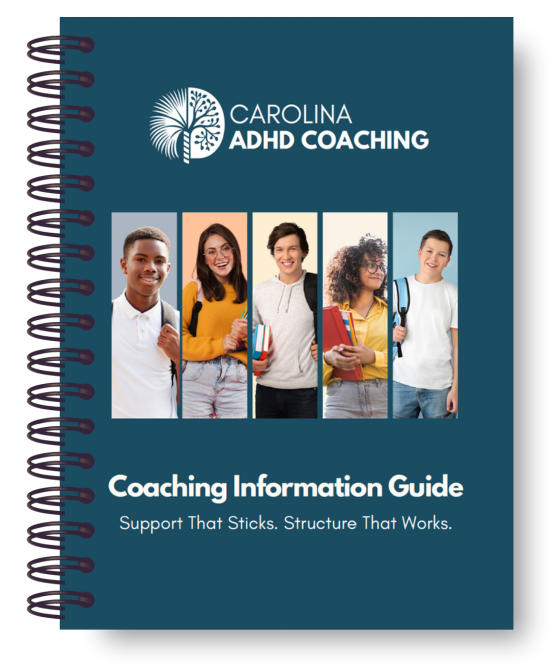
Get an inside look at how our coaching works, what to expect, and how to get started. It’s free — and packed with helpful info for parents and students!
Download the Guide