You’ve probably heard about ADHD coaching—but why does it actually help? What makes it so effective?
If you’ve been wondering, you’re not alone. Many parents tell us:
“I’ve tried everything—why would coaching make the difference?”
That’s exactly what we’ll explore here.
Why ADHD coaching works: It helps the ADHD brain by teaching skills that align with how neurodivergent brains function—not how neurotypical systems expect them to function. And there’s research to back it up.

In this post, we’ll break down:
✅ How ADHD coaching supports the brain
✅ Evidence-based techniques used in coaching
✅ Real-world outcomes families see
✅ Why teens and young adults especially benefit from coaching
Quick takeaway: ADHD coaching is not about “fixing” your child. It’s about giving them the tools and strategies that finally work for their brain—helping them build confidence, independence, and real-life skills.
The ADHD Brain: Why Traditional Supports Aren’t Always Enough
Here’s an “aha” moment for many parents: ADHD brains truly are wired differently.
Understanding that can help explain why ADHD coaching works—when other strategies sometimes don’t.
Research shows that the ADHD brain operates differently in both structure and function. For example:
✅ The prefrontal cortex, which is responsible for executive functions like decision-making, planning, and impulse control, shows distinct patterns of activity in individuals with ADHD.
✅ Neurotransmitters like dopamine and norepinephrine—which impact focus, motivation, and reward processing—are often dysregulated in ADHD brains.
✅ These neurological differences explain why traditional organization tips, school planners, and generic time management strategies often fall flat for students with ADHD.
An ADHD coach helps by offering personalized strategies that actually work with the ADHD brain, rather than against it.
For example:
- Using external accountability to support dopamine-driven motivation
- Teaching chunking and pacing to work with attentional rhythms
- Building custom routines that feel rewarding and doable for the student
As expert Dr. Russell Barkley puts it, “ADHD is not a disorder of knowing what to do, but of doing what you know.” (Barkley, Development and Psychology) — which is why external structure and accountability are so critical.
When supports are aligned with how the ADHD brain functions, students are far more likely to follow through—and progress builds from there.
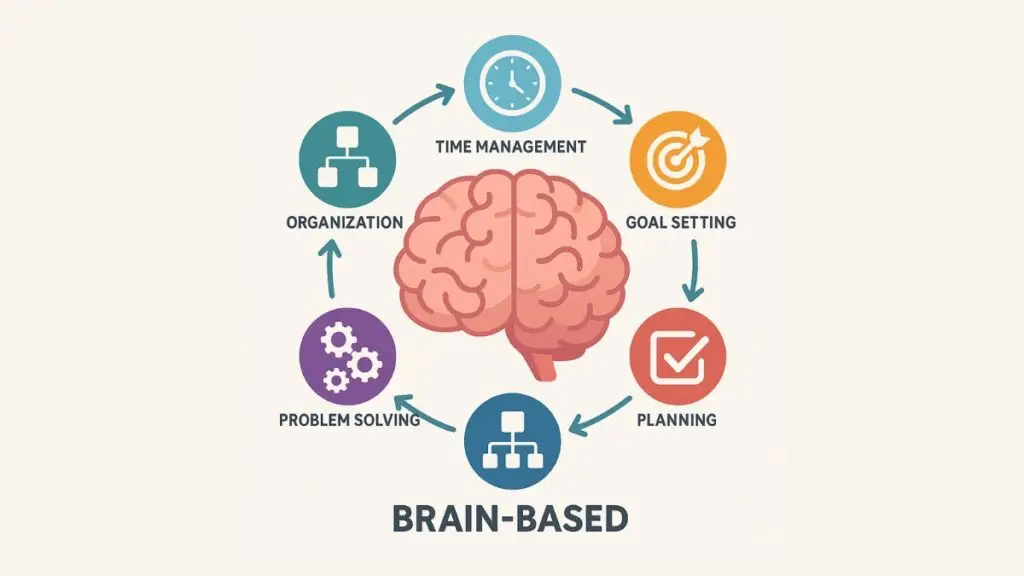
How ADHD Coaching Works With the Brain—Not Against It
So if the ADHD brain is wired differently… why does ADHD coaching work so well?
Because the strategies used in coaching are designed to work with the ADHD brain’s natural patterns—not fight against them.
Research shows that people with ADHD respond better to supports that provide external structure, immediate feedback, and accountability (Barkley, 1997). ADHD coaching leverages exactly that.
Here’s how:
✅ External Accountability Boosts Dopamine
One reason ADHD coaching works is that having a coach provides external accountability—which taps into the dopamine reward system.
ADHD brains often struggle with internal motivation, but thrive when there’s a clear, consistent external partner keeping them on track (National Library of Medicine).
✅ Personalized Strategies Beat Generic “Tips”
ADHD brains don’t benefit from one-size-fits-all “time management hacks.” Coaching provides custom tools that fit each student’s attentional rhythms, executive function profile, and real life.
✅ Reinforcing Executive Function Pathways
Through consistent coaching, students practice the skills that ADHD brains need most—like time estimation, task initiation, planning, and self-monitoring (Journal of Attention Disorders, 2010).
Neuroplasticity research shows that these skills can improve with practice, especially when guided by structured coaching.
✅ Creating Real-World Success Experiences
ADHD coaching helps students build a series of small wins—which is crucial because success breeds motivation. Each success reinforces positive neural pathways, building both executive skills and confidence over time.
Bottom line: ADHD coaching works because it matches how the ADHD brain is wired to learn, build habits, and stay motivated—making it an ideal fit for students who haven’t responded to traditional strategies.
Evidence-Based Techniques in ADHD Coaching
Why does ADHD coaching work so well? Because it’s not just tips and tricks — it draws from proven, practical techniques designed to help the ADHD brain thrive.
Here are some of the key methods used in ADHD coaching:
✅ Cognitive-Behavioral Techniques (CBT)
CBT-inspired strategies help students challenge unhelpful thought patterns, reframe perfectionism, and develop practical action steps for daily life.
✅ Mindfulness Practices
Mindfulness techniques help students reduce overwhelm, improve emotional regulation, and stay more present when approaching tasks or challenges.
✅ Accountability & External Structure
ADHD brains thrive with external cues and consistent accountability — which is why regular coaching check-ins are so effective for reinforcing new habits.
✅ Executive Function Skill-Building
Coaching systematically helps students build key EF skills:
- 🧠 Time management
- 🧠 Planning & prioritization
- 🧠 Task initiation
- 🧠 Working memory
- 🧠 Self-monitoring & reflection
✅ Emotional Regulation Support
Many students with ADHD also struggle with emotional intensity. Coaching helps them develop tools to:
- 🚀 Manage frustration
- 🚀 Reduce anxiety
- 🚀 Navigate social interactions
- 🚀 Build resilience after setbacks
The bottom line:
ADHD coaching helps students strengthen the skills they need while honoring how their brain works best — making it a supportive and empowering approach.
Why Teens & College Students Especially Benefit from ADHD Coaching
Teens and young adults with ADHD face unique challenges as they navigate school, social life, and growing independence.
ADHD coaching provides support exactly where it’s needed most:
✅ Transitions to independence — coaching helps teens and college students build life skills they’ll need as they move toward managing their own schedules, responsibilities, and goals.
✅ Executive function development — coaching directly targets the skills that are often underdeveloped at this stage: time management, organization, planning, and emotional regulation.
✅ Neutral accountability — many teens resist hearing guidance from parents, but respond well to a trusted outside coach who supports them without judgment.
✅ College prep & success — for high schoolers planning for college, or current college students juggling academics and life on their own, ADHD coaching can make the difference between surviving and thriving.
Get an inside look at how our coaching works, what to expect, and how to get started. It’s free — and packed with helpful info for parents and students!
Download the Guide