
ADHD hyperfocus can feel like a superpower—hours pass, work flies, and deep concentration makes hard tasks finally click. But without a plan, ADHD hyperfocus can also backfire: missed meals, blown bedtimes, abandoned responsibilities, and the post-sprint crash that makes tomorrow harder.
This post shows you how to keep the upside of ADHD hyperfocus while preventing the fallout. You’ll learn what hyperfocus is (and isn’t), when to invite it on purpose, and how coaching turns raw intensity into steady, repeatable progress.
We’ll cover practical frameworks—timeboxing, external cues, and “finish-line” definitions—so you start and stop on schedule.
You’ll see executive function tools that pair perfectly with ADHD hyperfocus: two-minute launches, one-tab workspaces, checkpoint timers, and simple recovery rituals that protect sleep, nutrition, and next-day momentum.
We’ll map the tasks that deserve deep immersion (drafting, complex problem-solving, creative production) versus the ones better suited to short sprints (admin, retrieval practice), and we’ll show you how to build a weekly routine that rotates both.
If hyperfocus tends to appear only at night or under deadline panic, you’ll learn how to shift it earlier with cues, accountability, and environment design—no heroics required.
For families and students, we’ll translate strategies into home and school routines; for adults, we’ll add tools for meetings, email, and project pipelines.
Throughout, you’ll find coaching prompts to personalize what works—energy tracking, task matching, and micro-experiments that convert “sometimes amazing” into “consistently good.”
By the end, ADHD hyperfocus becomes something you can call on deliberately, contain with clear boundaries, and recover from smoothly—so you get the best of that laser focus without sacrificing health, relationships, or tomorrow’s plan.
What “hyperfocus” is—and why it’s worth taming
When people describe getting “in the zone,” they’re pointing at a real attention state that compresses time, blocks distractions, and unleashes deep productivity. In healthy doses, this state powers creative breakthroughs and complex problem-solving. Left unmanaged, it can steamroll meals, sleep, and relationships. This post shows you how to capture the upside, contain the downside, and turn intense focus into a predictable system you can use on demand.
Where ADHD hyperfocus comes from (the brain basics)
Dopamine and norepinephrine shape how the brain prioritizes what’s interesting, urgent, or rewarding. When a task lights up those systems (novelty, challenge, or immediate feedback), ADHD hyperfocus can lock on tightly. That lock helps performance, but it narrows awareness of time, signals, and context—why alarms are missed and “five more minutes” becomes two hours.
The paradox: a superpower with guardrails
Think of hyperfocus like a high-performance car: amazing on a track, dangerous on a sidewalk. Without clear routes, it jumps the curb into all-night sessions, skipped responsibilities, and next-day burnout. With lanes, signs, and a finish line, it becomes a reliable engine for hard work.
When ADHD hyperfocus helps (and when it hurts)
Helpful: drafting big sections of a paper, debugging gnarly code, designing media, analyzing primary sources, building a portfolio piece, or mastering a new technique.
Risky: open-ended internet dives, games with infinite quests, “perfecting” minor details, or doing low-value admin because it’s more stimulating than the real priority. The coaching goal is to steer ADHD hyperfocus toward high-impact tasks and away from rabbit holes.
A coaching frame that makes hyperfocus safe
We use a three-part framework—Define → Contain → Recover—to turn intense focus into sustainable results.
- Define the target: what “done” looks like, the very first step, and how progress will be measured.
- Contain the work: length, environment, external cues, and a social guardrail.
- Recover on purpose: off-ramps, reset rituals, hydration/food, and a quick debrief.
Why ADHD hyperfocus needs a “finish line” (not just a start)
The brain loves novelty; finishing rarely feels novel. Before you begin, write a one-sentence finish line: “Draft 300 words for section two,” or “Solve problems 7–14 and check answers.” People who predefine a finish line end sessions earlier, feel less guilt about stopping, and resume faster the next day.
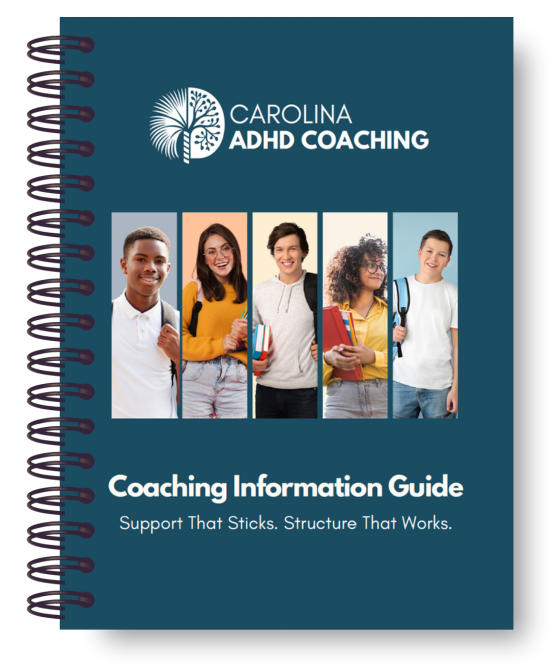
Get an inside look at how our coaching works, what to expect, and how to get started. It’s free — and packed with helpful info for parents and students!
Download the GuideThe Timebox Trio: three ways to contain deep work
Timeboxing turns boundless effort into focused sprints. Use one of these per session:
- Fixed box: 50 minutes on, 10 off—end when the clock says stop.
- Quota box: End after you hit your output (e.g., 300 words, 8 questions, 1 design screen).
- Milestone box: Stop at the next natural seam (end of chapter/section).
ADHD hyperfocus responds best when the box is visible (a large analog timer) and someone else knows when it ends.
Start cues that flip the switch without drama
Waiting for motivation is a trap. Use rituals that trigger ADHD hyperfocus quickly: clear the desk, set one tab, put your phone in another room, press start on a physical timer, and read your “first line” out loud. Routines beat willpower.
Stop cues that you’ll actually obey
Stopping is the hard part. Stack two of these:
- Social gate: text a partner: “Timer ends at 6:10—check on me.”
- Environmental change: lights up, music off, stand and stretch at the bell.
- Hard constraint: a class, commute, or meeting you must attend.
The more concrete the boundary, the better ADHD hyperfocus disengages.
What to work on: a simple task-matching matrix
Create four buckets and sort today’s tasks:
- Heavy + High value → prime for ADHD hyperfocus (papers, data analysis, complex builds).
- Heavy + Low value → split into smaller steps or delegate.
- Light + High value → do first with a short sprint (emails that unlock progress).
- Light + Low value → batch or drop.
You want your deepest attention reserved for Bucket 1. Everything else gets sprints or gets cut.
Energy management: the fuel behind ADHD hyperfocus
Sleep, movement, hydration, and protein are boring… and decisive. Track your best 90-minute windows over a week. Protect one of those windows each day for deep work. Hyperfocus without fuel becomes “crashfocus.”
Build a weekly cadence you can repeat
Sustainable success comes from rhythm, not heroics. Try this structure:
- Two to four deep blocks on Tue–Thu (or your highest-energy days).
- Short sprints around activities to process admin and retrieval practice.
- One weekly review (15–20 minutes) to plan which tasks deserve hyperfocus next week.
Used consistently, this reduces decision fatigue and makes ADHD hyperfocus purposeful, not accidental.
Tools that play well with ADHD hyperfocus

- Analog timer on your desk—visible, silent tick, big red dial.
- One-tab workspace—task + single resource, nothing else.
- Noise solution—white noise, earplugs, or instrumental tracks.
- Task card—first step + finish line in one glance.
- Phone parking—charger outside the room.
Each tool removes one friction point and strengthens your contain/stop cues.
Body doubling: the simplest accountability layer
Working alongside a calm person (in person or on video) shrinks avoidance and provides a natural stop at the check-in point. For ADHD hyperfocus, the double’s job is not coaching; it’s pacing: confirm the first step, start the timer, and high-five the finish line.
Protecting relationships while using ADHD hyperfocus
Intensity can feel like absence to spouses, partners, roommates, or kids. Use a shared calendar block labeled “Deep Work—Ends at 6:10,” send a quick pre-start text, and build a post-work reconnection ritual (walk, tea, 5-minute recap). Boundaries turn admiration into support instead of resentment.
Students: school-ready routines that harness hyperfocus
For middle/high school and college learners, anchor deep work to predictable parts of the day—library carrel, late-morning free period, or the first hour after practice. Put the hardest subject in the first block and use retrieval sprints (flashcards/quizzes) before and after. ADHD hyperfocus will then lock onto meaningful output, not late-night panic.
Perfectionism vs progress: how to stop polishing forever
Perfectionism feeds on ambiguity. Cap polish rounds (e.g., “two passes only”), and define what “good enough” means before you start (criteria checklist). ADHD hyperfocus then works inside a frame, not a black hole.
Recovery rituals: end strong so tomorrow starts easy
Three steps:
- Mark the seam—write the next first step on a sticky note.
- Close the loops—save, back up, park tabs, phone back in the room.
- Refuel—water, snack, 90 seconds of movement.
- Recovery is not indulgence; it’s maintenance for the next session of ADHD hyperfocus.
Handle derailers without losing the day
You will get interrupted. Use the “3R Reset”: Recognize you’re off track, Rewind by reading your finish line aloud, Resume with a two-minute re-launch. Most sessions can be salvaged if you catch the drift early.
Technology boundaries that stick
Notifications are kryptonite. Put devices on Do Not Disturb, whitelist only true emergencies, and keep tempting sites blocked during blocks. For ADHD hyperfocus, the absence of friction is everything—make the right thing the easy thing.
Executive function strategies that pair with ADHD hyperfocus
- Task initiation: two-minute launch written down.
- Time estimation: guess → do → compare → adjust.
- Working memory: externalize steps and models.
- Self-monitoring: minute-4 check (“Am I doing what I said?”).
These habits prevent drift and make intensity productive.
The Hyperfocus Playbook (copy-ready)

Before you start
- Write the finish line in one sentence.
- Set the timer and tell a person when you’ll stop.
- Park the phone and clear the desk.
During the block
- One tab.
- Minute-4 check.
- Keep water within reach.
At the bell
- Stand up first.
- Log what you finished.
- Write the very next first step.
Use this exactly for two weeks; adjust times by energy level, not mood.
Common mistakes—and how to fix them fast
- Planning while doing: plan in a 5-minute sprint, then execute in the deep block.
- Moving the goalposts: don’t extend “just five more minutes” more than once.
- All-or-nothing weeks: one missed day doesn’t cancel the plan; restart with a 25-minute block.
- Over-reliance on crisis: if you only ignite under deadlines, add accountability before the deadline—share your finish line with someone 24 hours earlier.
How ADHD hyperfocus supports mental health (when used well)
Clear starts/stops reduce guilt and improve sleep consistency. Consistent wins raise self-efficacy, which lowers anxiety about big projects. You’re building proof that you can aim your attention rather than being dragged by it.
Coaching makes the system stick
A coach translates ideas into routines that fit your life: where to place blocks, how to choose tasks, which cues work for you, and how to troubleshoot derailers. In sessions, we test micro-experiments and keep what works. Over 3–4 weeks, ADHD hyperfocus becomes a tool you use on purpose, not a state that uses you.
Student case mini-examples
- High schooler, essays: two 45-minute blocks/week with a thesis-to-topic-sentence checklist; sprints for quotes and citations; outcome: drafts finished two days earlier, no Sunday panic—ADHD hyperfocus reserved for real writing.
- College STEM: 60-minute block for problem sets; 10-minute review sprint; phone in locker; outcome: fewer late-night marathons, more consistent scores.
Make It Visible: Tiny Data at Home and School (for ADHD hyperfocus)
Track three simple metrics—time to launch, finish-line hit rate, and energy after work (1–5)—and review them weekly with your student and, when relevant, teachers.
If launches are slow, shorten blocks and add body doubling; if outcomes feel thin, swap one sprint for a deep block to channel ADHD hyperfocus into high-value tasks.
At home, post a one-page weekly plan on the fridge, label deep-work blocks with start/stop times, and celebrate starts and stops (not just grades).
Keep a shared charging station to protect sleep and make routines portable from home to school. In class, teachers can chunk complex tasks, provide quick models/exemplars, build a minute-4 check-in, and allow noise-management tools.
Teach students to write a one-sentence finish line before independent work; done well, this invites productive ADHD hyperfocus without chaos and makes progress visible to everyone.
FAQs
How long should a deep block be?
Start with 25–45 minutes; extend by 5–10 minutes as stamina improves.
What if I can’t stop?
Use a dual stop cue: social check-in + environmental change. Pre-commit to a hard constraint (meeting, class, pickup).
Can I use music?
Yes—instrumental only. Make “music off” part of your stop ritual so ADHD hyperfocus relinquishes the wheel.
Is this the same as flow?
Related, not identical. Flow is optimal challenge + skill; hyperfocus can attach to low-value tasks. Your job is to attach it to the right work.
Put it into play this week
- Pick one heavy, high-value task.
- Schedule a single deep block in your best energy window.
- Write a one-sentence finish line and tell one person when you’ll stop.
- Run the block with one-tab, timer, and a stop ritual.
- Repeat twice more this week. Review your three metrics on Sunday.
ADHD hyperfocus doesn’t need to be rare or risky. With the right definition, containment, and recovery, it becomes a dependable part of how you learn, work, and create.
Coaching that Fits Your Real School Day

We specialize in executive-function and study-skills coaching for middle, highschool and college students. Our job is to help you build simple routines that actually run: when to study, what to start first, and how to launch in under two minutes—so momentum shows up on time.
We help students with ADHD turn school into a repeatable system instead of a daily scramble. Through 1:1 coaching, we build executive-function skills—task initiation, time management, planning, organization, and self-monitoring—using simple tools like visible timers, one-tab workspaces, checklists, and “first-step” scripts.
With ADHD hyperfocus, we don’t try to tame a superpower; we aim it. We design clean runways for deep work (one-tab workspace, visible timer, one-sentence finish line) and gentle off-ramps that protect sleep, meals, and family time. The result is intensity with boundaries: you lock in when it matters, then step out without the crash.
We begin by mapping each student’s energy windows and matching them to high-value school tasks—papers, labs, problem sets, projects—so ADHD hyperfocus is saved for the work that moves grades and confidence. Lighter tasks get short, satisfying sprints.
We install cues that flip the switch quickly: clear desk, first step written, two-minute launch, and one stop signal you’ll actually honor. Progress stays visible with tiny data—time to launch, finish-line hit rate, and energy after study—reviewed in a five-minute weekly check to fine-tune the plan.
Parents get a calm, practical playbook: post the weekly plan, label start/stop times for deep blocks, praise starts and stops (not just grades), and keep a family charging station to protect sleep. Teachers (when appropriate) get quick, classroom-friendly routines—models before independent work, minute-4 check-ins, and permission for simple noise-management tools—so the student’s system works at school too.
If your student needs a plan that fits real life—sports, rehearsals, jobs, homework—we’ll build it: clear, repeatable, and personalized. Bring the toughest assignment; we’ll set the runway, light the cues, and coach the follow-through so ADHD hyperfocus becomes a reliable engine for sustainable academic success.
Get an inside look at how our coaching works, what to expect, and how to get started. It’s free — and packed with helpful info for parents and students!
Download the Guide