
If you are wondering how to parent a child with ADHD without feeling like every day turns into a fight, you are not alone.
A lot of parents love their child deeply and still feel worn down by the constant friction. You ask them to get dressed, and it becomes an argument. You remind them to put their backpack by the door, and somehow it turns into a meltdown. You try to help with homework, and within minutes everyone is frustrated. You set limits around screens, bedtime, chores, or transitions, and the pushback feels bigger than the moment should require.
This is one of the hardest parts of how to parent a child with ADHD in real life. It is not just about managing symptoms. It is about trying to hold structure, boundaries, and connection all at the same time when your child’s nervous system, executive function, and emotional regulation can make ordinary moments feel unexpectedly intense.
Parents often ask, “Why does everything have to become a battle?”
That is a fair question.
And the answer usually is not that your child wants to make life hard. More often, it is that the current pattern between demand and response is not working for your child’s brain.
That is why learning how to parent a child with ADHD often means learning how to reduce friction, not just increase discipline. It means recognizing when a child is overwhelmed instead of oppositional, when a routine is too vague instead of being ignored on purpose, and when repeated correction is feeding the power struggle instead of ending it.
As a coach, I see this pattern all the time. Parents often come in exhausted, convinced they need to be firmer, more consistent, or somehow more in control. But what usually helps most is not becoming harsher. It is becoming clearer, calmer, and more strategic.
If you have been trying to figure out how to parent a child with ADHD without constant power struggles, this post will walk you through why those battles happen, what usually makes them worse, and what actually helps build more calm, cooperation, and connection at home.
Why Power Struggles Happen So Easily in ADHD Homes

One of the first things to understand about how to parent a child with ADHD is that many daily conflicts are not just about behavior. They are about nervous systems, transitions, executive function, frustration tolerance, and the child’s ability to manage demands in the moment.
A direction that feels simple to an adult may not feel simple to a child with ADHD.
“Go get your shoes.”
“Finish this worksheet.”
“Put your phone away.”
“Start your homework.”
“Brush your teeth and get ready for bed.”
Each of those directions asks for multiple internal skills:
- stopping what they are currently doing
- shifting attention
- managing frustration
- remembering what comes next
- organizing materials or body movement
- tolerating the fact that the task may be boring or difficult
That is why understanding how to parent a child with ADHD requires looking beneath the surface. The child may not be reacting only to your request. They may be reacting to the invisible demands hidden inside the request.
And once those demands pile up, what looks like defiance can quickly become resistance, argument, delay, shutdown, or emotional escalation.
This is one reason many parents feel like they are “always nagging.” They are trying to bridge the gap between what needs to happen and what their child can access consistently in that moment.
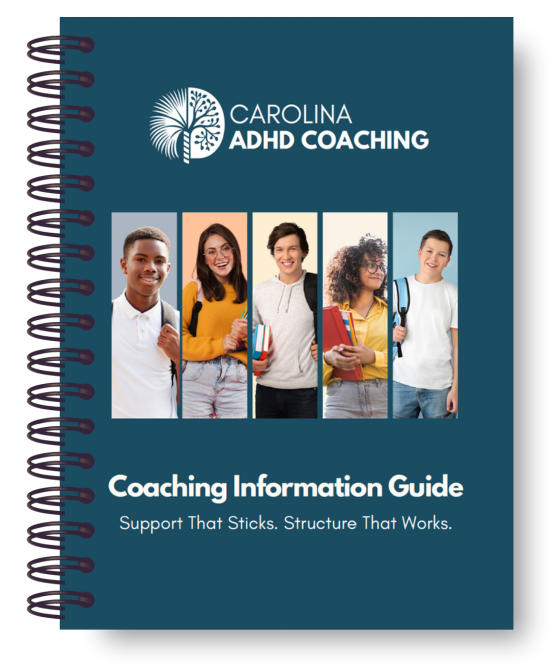
Get an inside look at how our coaching works, what to expect, and how to get started. It’s free — and packed with helpful info for parents and students!
Download the GuideHow to Parent a Child With ADHD by Looking Under the Behavior
If you are wondering how to parent a child with ADHD without feeling like every day turns into a fight, you are not alone.
A lot of parents love their child deeply and still feel worn down by the constant friction. You ask them to get dressed, and it becomes an argument. You remind them to put their backpack by the door, and somehow it turns into a meltdown. You try to help with homework, and within minutes everyone is frustrated. You set limits around screens, bedtime, chores, or transitions, and the pushback feels bigger than the moment should require.
This is one of the hardest parts of how to parent a child with ADHD in real life. It is not just about managing symptoms. It is about trying to hold structure, boundaries, and connection all at the same time when your child’s nervous system, executive function, and emotional regulation can make ordinary moments feel unexpectedly intense.
Parents often ask, “Why does everything have to become a battle?”
That is a fair question.
And the answer usually is not that your child wants to make life hard. More often, it is that the current pattern between demand and response is not working for your child’s brain.
That is why learning how to parent a child with ADHD often means learning how to reduce friction, not just increase discipline. It means recognizing when a child is overwhelmed instead of oppositional, when a routine is too vague instead of being ignored on purpose, and when repeated correction is feeding the power struggle instead of ending it.
As a coach, I see this pattern all the time. Parents often come in exhausted, convinced they need to be firmer, more consistent, or somehow more in control. But what usually helps most is not becoming harsher. It is becoming clearer, calmer, and more strategic.
If you have been trying to figure out how to parent a child with ADHD without constant power struggles, this post will walk you through why those battles happen, what usually makes them worse, and what actually helps build more calm, cooperation, and connection at home.
How to Parent a Child With ADHD Without Making Every Request Feel Like a Threat
Many children with ADHD experience repeated correction all day long.
At school they hear:
pay attention
sit down
finish that
that’s not what I asked
please stop talking
where is your folder
you forgot this again
Then they come home and hear:
put your shoes away
start your homework
go shower
clean your room
turn that off
come back here
None of those requests are unreasonable. But over time, a child can start to experience requests as pressure rather than guidance.
That is one reason how to parent a child with ADHD is not just about what you ask. It is also about how often your child feels corrected, rushed, or under strain.
When kids feel like adults are always on them, even neutral requests can start to feel loaded. That is when power struggles grow.
A child may argue not because the request is impossible, but because their nervous system is already bracing against one more demand.
This is why how to parent a child with ADHD often works better when parents reduce the correction load where they can. Fewer words. Clearer directions. Better timing. More visual structure. More calm, less commentary.
The goal is not to stop having expectations. The goal is to stop making every request feel like another battle line.
What Usually Makes Power Struggles Worse
Parents do not create power struggles on purpose. Most are trying to get through the day. But there are a few patterns that tend to make conflict worse when you are learning how to parent a child with ADHD.
One is giving too many instructions at once. A child hears the first step, loses the rest, gets overwhelmed, and resists.
Another is trying to reason during emotional flooding. When a child is already dysregulated, explaining harder usually does not lead to cooperation. It leads to more stress.
Another is using repeated verbal reminders when the problem is not hearing but follow-through. Parents often say the same thing five times because they feel like they have no choice. The child often experiences that as pressure, not support.
Another is turning every problem into a character issue. When children hear that they are lazy, careless, disrespectful, or not trying hard enough, shame rises and flexibility drops.
This is why how to parent a child with ADHD often becomes easier when parents focus less on intensity and more on fit.
Ask:
Is this instruction clear enough?
Is this the right timing?
Does my child need a visual cue instead of more words?
Are they capable of this independently yet, or do they still need scaffolding?
Are we stuck in a pattern where everyone is reacting instead of planning?
Those are the kinds of questions that lower the temperature.
How to Parent a Child With ADHD Using Structure Instead of Constant Pressure

If you want to know how to parent a child with ADHD without constant power struggles, structure is one of the most powerful tools you have.
Not rigid structure.
Not controlling structure.
Clear, supportive, visible structure.
Children with ADHD often do better when expectations are externalized. Instead of holding everything in their head, they can see what comes next, what is required, and how to move through it.
That may look like:
- a morning checklist
- a bedtime sequence
- a visual timer
- a homework routine
- a backpack station by the door
- a written sequence for chores
- a “first, then” routine for transitions
This matters because how to parent a child with ADHD gets easier when parents stop trying to be the system for their child every minute of the day.
The more the environment does the reminding, the less the parent has to.
And the less the parent has to repeat, chase, and correct, the fewer battles you tend to have.
How to Parent a Child With ADHD by Regulating First
This is one of the biggest shifts I teach families.
When a child is emotionally activated, the first job is not teaching. It is regulating.
That may sound obvious, but in real life it is hard. Parents are tired. The routine needs to keep moving. There is pressure. The school bus is coming. Homework needs to get done. Bedtime is late. And yet, if your child is already in full fight, flight, or freeze, that is usually not the moment they can absorb your lesson.
This is one reason how to parent a child with ADHD often looks so different from the outside. It may involve pausing, getting low, shortening language, staying close, and saving the longer conversation for later.
That does not mean the behavior gets ignored.
It means the order matters.
Connection first.
Regulation first.
Problem-solving after.
For many families, this is the moment things begin to shift. When they stop expecting their child to think clearly in the middle of flooding, they stop escalating so many unnecessary fights.
And once the nervous system settles, cooperation often becomes much more possible.
Why Connection Matters So Much
Some parents hear “connection” and worry it means becoming too soft. But in my experience, connection is one of the most powerful parts of how to parent a child with ADHD well.
Connection lowers defensiveness.
Connection increases recovery.
Connection makes correction less threatening.
Connection reminds the child that the relationship is bigger than the mistake.
Children who are corrected often — especially at school — are at risk of feeling like every adult interaction is about what they did wrong. When home becomes only one more place of correction, tension grows.
That is why how to parent a child with ADHD is not just about rules and follow-through. It is also about warmth, repair, and enough positive connection that your child does not feel like the relationship is built on constant fixing.
This does not mean avoiding all hard conversations. It means making sure your child is getting more from you than instructions and correction.
How to Parent a Child With ADHD Without Constant Yelling
A lot of parents are carrying guilt about this.
They do not want to raise their voice. They do not plan to escalate. But after repeating the same direction over and over, it happens.
If that is your reality, you are not alone.
The problem is that yelling usually gets attention through stress, not through skill. It may produce movement in the moment, but it rarely builds the systems that reduce future conflict.
This is why how to parent a child with ADHD often involves reducing the need for repeated verbal escalation in the first place.
That may mean:
- saying less
- using visual cues
- touching base before transitions
- lowering the number of tasks per direction
- choosing the most important battle
- stepping away from unnecessary arguments
- building routines outside the hot moment
Parents do not need more shame around yelling. They usually need better systems so they are not pushed to the edge as often.
That is a very different conversation, and a much more helpful one.
How Schools and Home Can Work Together
Sometimes the power struggles at home are closely connected to what has been happening at school.
If a child has spent the day feeling corrected, overwhelmed, embarrassed, socially stressed, or behind, the after-school version of that child may be much more fragile.
This is why how to parent a child with ADHD often requires seeing the whole picture, not just the moment in front of you.
If mornings are hard, school pressure may be part of it.
If homework turns into conflict, shame may be part of it.
If your child is melting down after school, depletion may be part of it.
This is also why school collaboration can help reduce home conflict. When school supports improve, the emotional load children carry home often decreases too.
How to Parent a Child With ADHD When You Feel Burned Out Too
Parents matter in this conversation too.
One of the hardest truths about how to parent a child with ADHD is that even the most loving, skilled parent becomes less patient when they are exhausted, unsupported, and carrying too much alone.
If you feel like you are always on, always monitoring, always planning ahead, always helping your child recover, it makes sense that you would feel tired.
That does not make you a bad parent. It makes you a human one.
This is why support matters. Sometimes families need better routines. Sometimes they need school help. Sometimes they need coaching. Sometimes parents need someone to help them stop feeling like every hard moment means they are failing.
When parents get support, they usually parent with more clarity and less panic. And that helps the whole household.
How Coaching Helps Reduce Power Struggles

This is one reason coaching can be so helpful.
The goal is not just to stop arguments. It is to understand what is causing them and build better systems around those patterns.
When families get support around how to parent a child with ADHD, they often begin to see:
where the friction points really are
what the child can do independently
where more scaffolding is still needed
how to reduce unnecessary correction
how to respond to overwhelm without feeding the fight
how to build routines that actually fit
Coaching can also help the child build executive function skills so the parent is not carrying the whole system alone.
That is where many families feel the greatest relief.
FAQ: How to Parent a Child With ADHD
How do you parent a child with ADHD without constant battles?
The best approach usually involves more structure, fewer repeated verbal corrections, calmer routines, emotional regulation support, and realistic expectations. Learning how to parent a child with ADHD often means focusing on prevention and scaffolding rather than reacting in the moment.
Why does my child argue about everything?
Children with ADHD often struggle with transitions, frustration tolerance, impulsivity, and demand overload. What looks like arguing may be a stress response, not just intentional defiance.
Should I be stricter if my child has ADHD?
Not necessarily. How to parent a child with ADHD is not about being softer or harsher. It is about being more effective. Clear structure, calm delivery, and better support usually work better than escalating pressure.
What helps reduce power struggles at home?
Visual routines, fewer words, better timing, consistent anchors, calmer transitions, and support for regulation often reduce conflict much more than repeated reminders or punishment alone.
Final Thoughts
If you have been trying to figure out how to parent a child with ADHD without feeling like every day turns into a struggle, I hope you hear this clearly:
You do not need to parent harder.
You need strategies that fit better.
The usual advice often misses what ADHD changes in daily life. It misses the executive function load, the emotional intensity, the transition difficulty, the shame, the overwhelm, and the invisible work families are already doing.
But once parents begin to understand those patterns, things often start to feel more workable.
Not perfect.
Not easy every day.
But more possible.
And for many families, that is where the real shift begins.
Get an inside look at how our coaching works, what to expect, and how to get started. It’s free — and packed with helpful info for parents and students!
Download the Guide